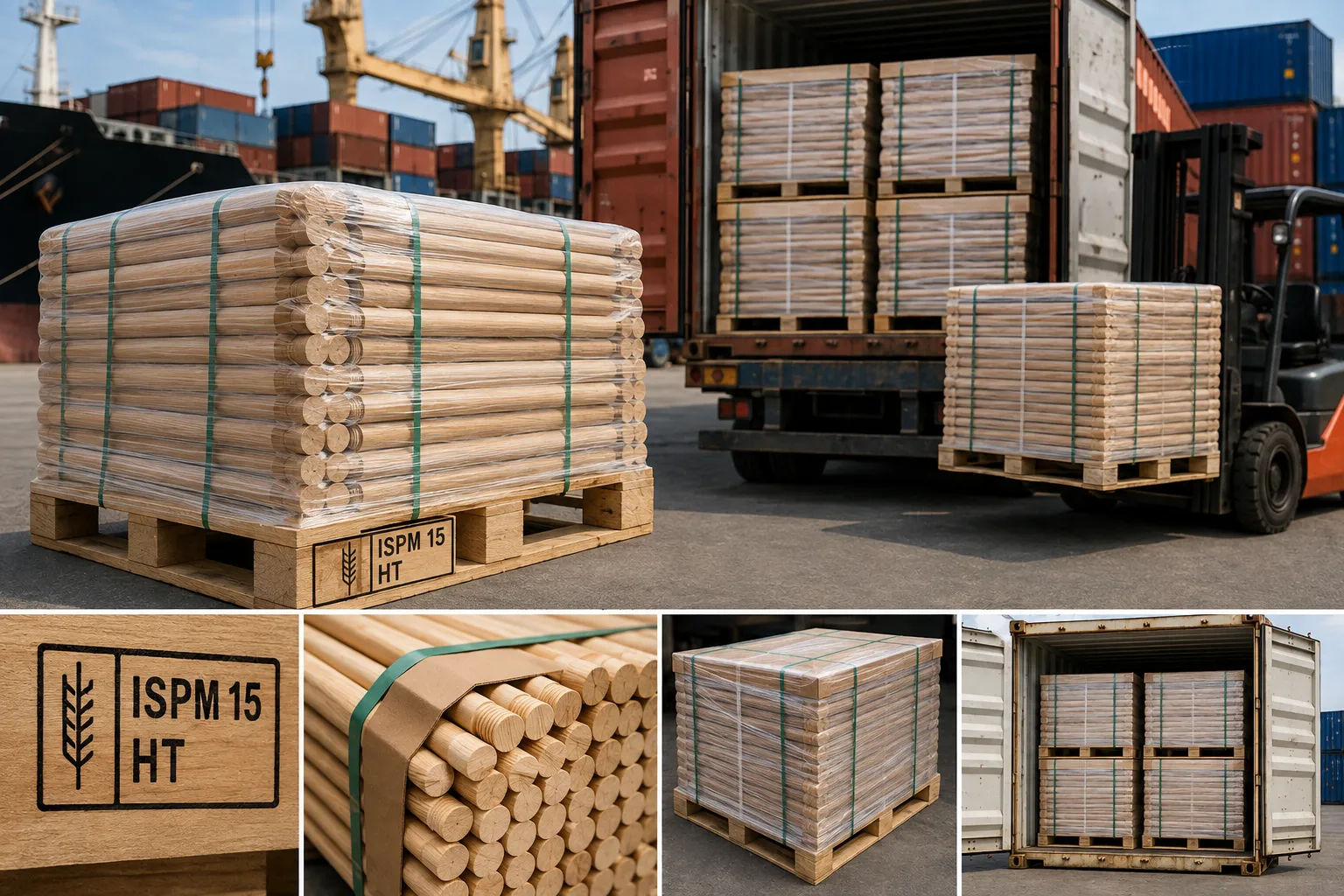
For international supply chain executives and wholesale timber importers, managing ocean freight logistics for bulk wooden products requires absolute precision. Shipping millions of unit handles annually across international borders involves navigating strict phytosanitary laws, ocean container weight limits, and moisture management protocols. When importing multi-container loads of pine broom handles or heavy-duty agricultural tool shafts, sub-standard packaging or non-compliant dunnage can result in severe port delays, expensive quarantine fees, or complete cargo destruction by customs authorities.
To safeguard capital investments and ensure seamless port clearance in European, American, and global markets, importers must enforce strict logistics and packaging protocols at the factory level. Below is an essential technical guide covering ISPM 15 standards, palletization strategies, and container loading efficiency.
1. ISPM 15 Compliance and Phytosanitary Protection
The International Standards for Phytosanitary Measures No. 15 (ISPM 15) is an internationally agreed-upon regulation developed by the International Plant Protection Convention (IPPC). Its core mandate is to prevent the international introduction and spread of plant pests through raw wood packaging materials used in global trade.
- Heat Treatment (HT) Requirement: All wooden pallets, crating, and dunnage used to support cargo must undergo heat treatment. The wood core must reach a minimum temperature of 56°C (132°F) for at least 30 continuous minutes.
- Official IPPC Stamp: Compliant packaging materials must carry a visible, permanently applied IPPC stamp. This mark includes the country code, producer registration code, and the treatment acronym (HT). Customs inspectors worldwide verify this mark before granting entry permits.
2. Advanced Palletization and Bundle Securing
High-volume handle transport relies on structural bundle design that maximizes container space while protecting individual wood pieces from mechanical impact during transit.
- Standardized Bundling: Handles are counted and bound into uniform bundles (typically 25 to 50 pieces per bundle) using high-tensile plastic or steel strapping. Protective corrugated cardboard caps are applied to threaded ends and domed tops to prevent structural damage during handling.
- Heavy-Duty Pallet Stacking: Bundles are stacked systematically onto ISPM 15 heat-treated wooden pallets. Interlocking stacking patterns distribute weight evenly, preventing load shifting inside ocean containers.
- Stretch Wrapping and Moisture Protection: Staked pallets are fully enclosed in heavy-gauge stretch wrap, reinforced with top-sheeting to create a protective barrier against humidity, sea spray, and dust during maritime shipping.
3. Container Load Optimization and Weight Distribution
Ocean freight costs are calculated per container unit; therefore, maximizing volume utilization while respecting statutory container gross weight limits is essential for unit-cost optimization. An experienced manufacturer carefully calculates container loading layouts for standard 20ft, 40ft, and 40ft High Cube (HC) dry containers.
Proper weight distribution prevents container tilting during crane hoisting and truck haulage. Furthermore, leaving adequate ventilation channels around pallet stacks prevents moisture condensation—often referred to as “container rain”—from dripping onto the wood cargo.
4. Integrating Logistics into Your Sourcing Strategy
Logistical compliance is the final link in a successful procurement strategy. To understand how packaging protocols fit into your vendor selection process, read our comprehensive guide on evaluating wholesale wooden broom handle manufacturers.
Additionally, protecting cargo against environmental degradation during sea transits relies heavily on prior factory processing. To review how raw timber moisture is controlled before packaging, explore our article on wood treatment and finishing specifications for export markets.
Streamline Your International Timber Supply Chain
Executing flawless export logistics protects your profit margins, prevents port rejections, and guarantees on-time delivery to destination warehouses. Working with an experienced timber manufacturer ensures that every pallet shipped complies fully with global trade regulations.
Partner with an established exporter to supply your inventory needs. Learn more about our international shipping capabilities by visiting our product page for certified Pine Tool Handles engineered for high-volume commercial export.